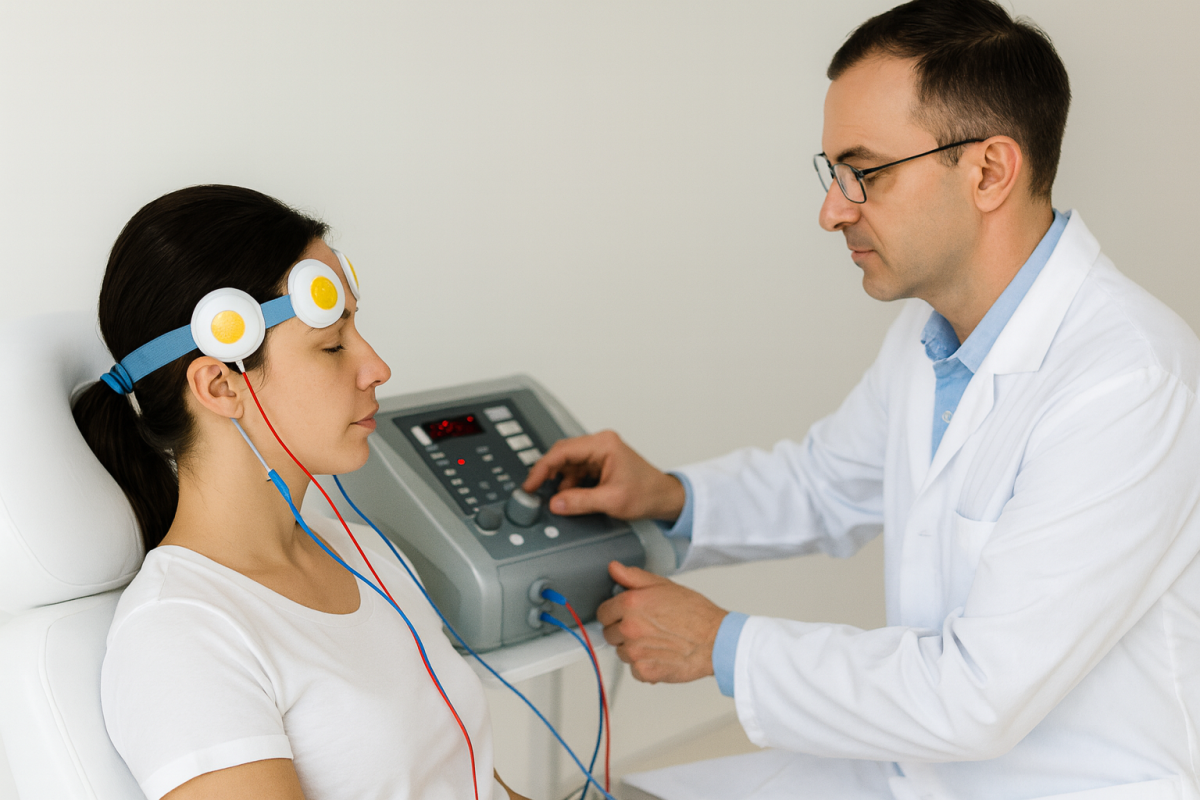
Transcranial Electroanalgesia (TEA)
Transcranial electroanalgesia: when electric current helps relieve pain
Transcranial electroanalgesia (TEA) is a method of influencing the brain with pulse currents of low and medium frequency (approximately 60–2000 Hz), which is used to reduce pain, anxiety, and tension of the nervous system. Unlike medication analgesics, TEA does not cause addiction, does not load the liver, and does not suppress consciousness.
Under the action of pulse current, the endorphin system of the brain is activated — the organism itself begins to intensively produce endorphins and serotonin. Exactly these substances answer for natural pain relief, stabilization of mood, and the sensation of inner calm. Therefore, TEA is applied not only for pain but also for conditions connected with chronic fatigue, anxiety, and disorders of sleep.
Main effects of transcranial electroanalgesia
Short-pulse action of electric current on structures of the brain triggers a whole series of neurophysiological reactions. Thanks to this, TEA has a complex therapeutic influence on the organism.
What happens in the organism during TEA
- the endorphin system activates — natural pain relief intensifies;
- the tone and reaction of vessels improves, microcirculation normalizes;
- the level of anxiety, tension, and internal «overload» decreases;
- the quality of sleep improves, the quantity of night awakenings decreases;
- regenerative processes in the nervous tissue are stimulated;
- the emotional background improves, fatigue decreases.
In clinical practice, TEA is used as an addition to medication therapy, physiotherapy, and psychotherapeutic approaches, especially for chronic pain syndromes and functional disorders of the nervous system.
Use of modern devices for transcranial electroanalgesia in the clinic «Graal»
In the clinic «Graal,» for conducting TEA, modern devices are applied with fine tuning of current parameters — frequency, amplitude, form of pulse, and duration of the session. This allows adapting the procedure to a specific clinical case: acute pain, chronic pain syndrome, vegetative disorders, anxious states.
Before including TEA in the plan of treatment, the doctor evaluates the neurological status, concomitant diseases, medication therapy, and possible contraindications. During the procedure, the specialist controls the sensations of the patient, softly corrects the strength of the current, and watches for the safety of the session. Such an approach allows combining the effectiveness of the methodology with a high level of comfort and safety.
When it is expedient to prescribe TEA and to whom it is contraindicated
Transcranial electroanalgesia is used as an auxiliary method for a wide spectrum of diseases of the nervous, cardiovascular, and digestive systems. Especially useful it is for conditions where it is important to combine pain relief with normalization of the emotional background.
Indications for transcranial electroanalgesia
- frequent headache, migraine, pains in the area of the neck and spine;
- diseases of joints, osteoarthrosis, rheumatoid polyarthritis;
- ischemic heart disease, cerebral atherosclerosis (by recommendation of a doctor);
- neuralgia of the trigeminal nerve, neuropathic pains, phantom pain;
- vegetative disorders, vegetative-vascular dystonia;
- anxious and depressive states, chronic fatigue, meteosensitivity;
- disorders of sleep, emotional and nervous exhaustion;
- withdrawal syndrome (alcoholic or narcotic) in the composition of complex therapy.
When TEA cannot be conducted
As with any method that influences the brain and cardiovascular system, transcranial electroanalgesia has a series of contraindications.
- acute psychotic disorders, epileptic seizures;
- expressed disorders of heart rhythm, angina, recently suffered infarction;
- acute phase of stroke, arachnoiditis of the brain;
- malignant neoplasms and cysts of the brain;
- closed craniocerebral trauma in the acute period;
- lesions of the scalp skin in places of applying electrodes;
- presence of a pacemaker, internal hearing aid, metal plates in bones of the skull;
- age under 5 years.
The final decision about the possibility of conducting TEA is taken by the doctor after an examination and analysis of medical documentation.
TEA in complex programs of recovery in the clinic «Graal»
In the clinic «Graal,» transcranial electroanalgesia is not used in isolation. It is included in complex programs of recovery for chronic pain, consequences of stress, anxiety disorders, and disorders of sleep. Depending on the clinical situation, TEA is combined with medication therapy, psychotherapeutic support, other types of physiotherapy, and programs of correction of lifestyle.
Such a multidisciplinary approach allows not only temporarily reducing pain but also influencing the deep mechanisms of its formation — overload of the nervous system, chronic stress, disorders of regulation of vascular tone. The patient receives a clear plan of treatment and accompaniment of specialists at all stages of recovery.
How the procedure of transcranial electroanalgesia passes
A session of TEA is conducted in calm conditions, in a specially equipped cabinet. The patient is positioned sitting or lying, closes eyes, and maximally relaxes. On the frontal area and occipital part of the head, electrodes are fixed with hydrophilic pads, moistened with water for better conductivity.
After this, the doctor gradually selects the strength of current: sensations of light warmth, tingling, or vibration under electrodes are allowed, but without pain or expressed discomfort. The voltage does not exceed safe values, and parameters of pulses are controlled by the apparatus and the specialist.
One session usually lasts 20–30 minutes; for expressed pain syndromes, duration can be increased to 40 minutes by recommendation of the doctor. For a stable therapeutic effect, usually, a course of 10–15 procedures is needed with certain periodicity. Repeat courses are possible after several months on the condition of positive dynamics and absence of new contraindications.
FAQ (Frequently Asked Questions)
-
Is transcranial electroanalgesia painful?
No, the procedure should not be painful. Light tingling or warmth under electrodes is allowed. If sensations become unpleasant, the doctor decreases the strength of current.
-
When to expect the first results?
In a part of patients, relief of pain and reduction of tension is felt already after the first sessions. A stable effect usually forms by the end of the course.
-
Is it possible to combine TEA with taking medicine?
Yes, the method is often applied together with medication therapy. It is important that the plan of treatment is coordinated by the treating doctor.
-
Does electroanalgesia cause addiction?
No, TEA does not have a narcotic or sedative effect, does not cause dependence, and does not worsen cognitive functions.
-
Is it possible to undergo TEA prophylactically?
The method is prescribed in the presence of concrete indications — pain, anxiety, disorders of sleep. The decision about prophylactic courses is taken individually by the doctor.
Зареєструйтесь онлайн перед приїздом.